
Overtime calculation in the Middle East: Rules, complexities, and what construction companies must know
Introduction
Overtime is an essential but often misunderstood aspect of workforce management across construction companies in the Middle East. On the surface, it might seem straightforward: work extra hours, pay extra. But in reality, overtime calculation is layered with country-specific labor laws, shift patterns, holiday rules, and job-site practices that turn payroll into a monthly challenge.
In this blog, we break down the key overtime rules across major Middle Eastern countries, the operational challenges construction HR teams face, and how modern tools can streamline this critical process.
Why Overtime Isn’t Just “Extra Hours”
For most construction firms, labor costs are one of the largest operating expenses. Overtime, when not managed well can inflate payroll costs, trigger compliance risks, and lead to worker disputes.
Common complexities include:
- Different OT rates for weekdays, weekends, and public holidays
- Distinctions between site staff, office staff, and outsourced workers
- Variations in what counts as “overtime” (e.g., shift overruns vs. pre-approved extra hours)
Overtime Laws by Country (With Comparison)
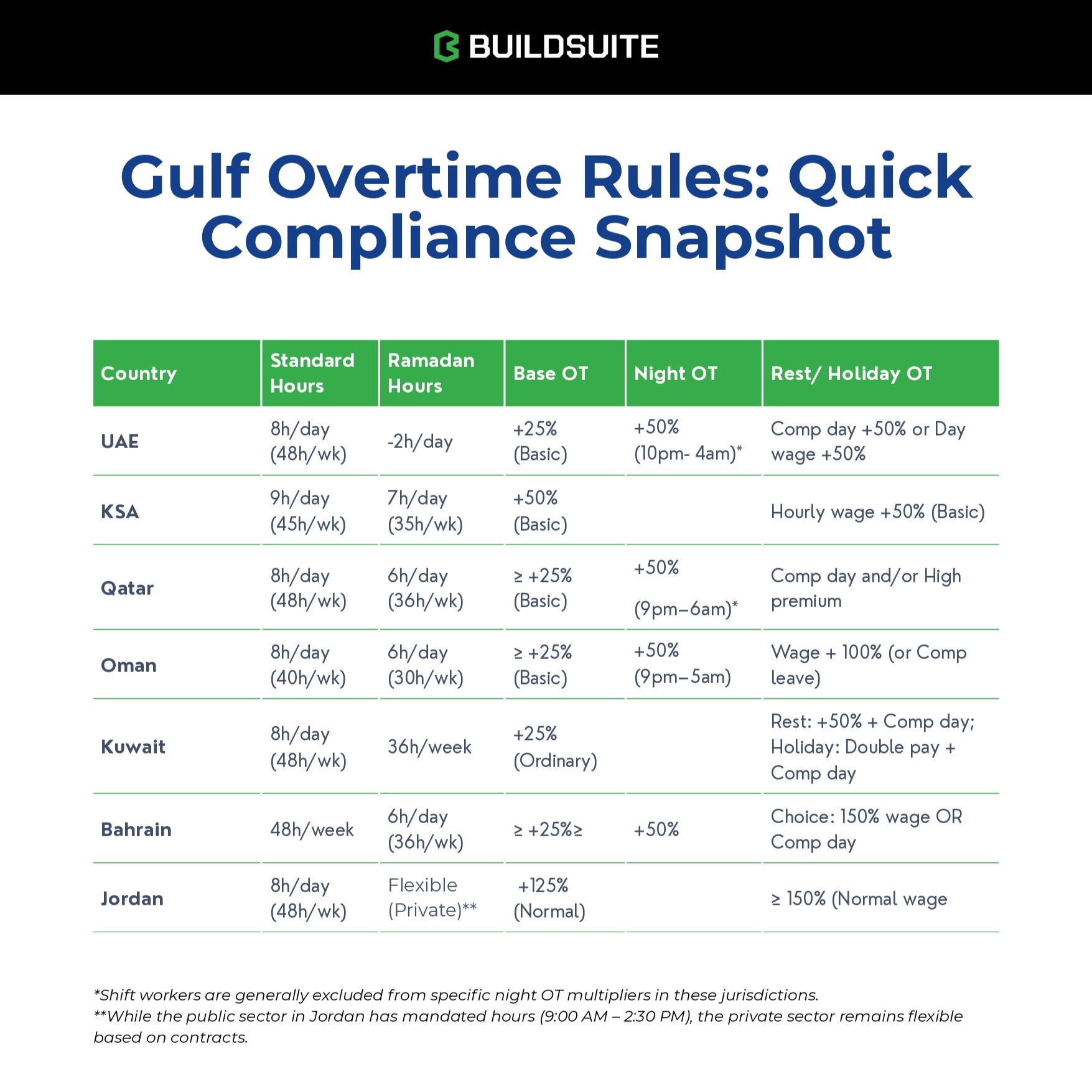
Labor laws across the GCC and wider Middle East are not uniform. Here’s a quick country-wise snapshot:
Country-Specific Nuances & Compliance Notes
UAE: The “Basic Wage” Focus
- Calculation: OT is strictly calculated on Basic Salary only. Allowances (housing, transport) are excluded.
- Formula: $Hourly Rate = \frac{Basic Salary}{30 \times 8}$.
- Caps: Total working hours cannot exceed 144 hours over a 3-week period without MoHRE approval.
Saudi Arabia: Holiday = Overtime
- Holiday Rule: Any work performed during Eid or National holidays is legally treated as overtime ($1.5 \times$ rate).
- Annual Cap: Generally capped at 720 hours/year, but can be exceeded with written worker consent.
Oman: “Forced” Overtime Premiums
- Emergency Work: If OT is required without consent (e.g., for emergency repairs or inventory), premiums jump to +50% (Day) and +75% (Night).
- 2026 Update: Total daily hours (regular + OT) are strictly capped at 12 hours.
Kuwait: Strict Quantitative Limits
- Operational Caps: OT is limited to 2 hours/day, 3 days/week, and a maximum of 90 days/year.
- Record Keeping: Employers are required to maintain a “Special Overtime Register” for labor inspections.
jordan: establishing internal bylaws
- Threshold: Any establishment with 10+ employees must have an internal bylaw approved by the Ministry of Labour clearly stating working hours and rest periods.
- Ramadan: Unlike other GCC states, Jordan’s Labour Law does not mandate a private-sector reduction; however, a 6-hour “market practice” is common.
comparison of night ot windows: Different countries define “night” differently for payroll purposes. Miscalculating the window can lead to significant compliance fines.
The Real-World Challenges for Construction HR
Even with legal knowledge, THE execution of overtime tracking is where most companies struggle:
- Manual Logs: Many sites still rely on WhatsApp messages or handwritten registers
- Shift Variability: Late deliveries, breakdowns, and rework often stretch work hours unpredictably
- Approval Gaps: OT often gets logged but not approved in time, causing disputes later
- Payroll Bottlenecks: HR teams scramble at month-end to clean, verify, and calculate OT across 5–10 projects
“Even 15 minutes of OT per day per worker, if unaccounted or overpaid, can create a massive payroll mismatch at scale.”

How Modern Tools Like BuildSuite Simplify Overtime
For HR managers, payroll leads, and site workforce teams across GCC construction projects, overtime tracking isn’t just a task it’s a compliance minefield. BuildSuite is designed to help your HR and workforce operations teams handle this complexity with precision and speed.
✅ What BuildSuite Workforce Offers:
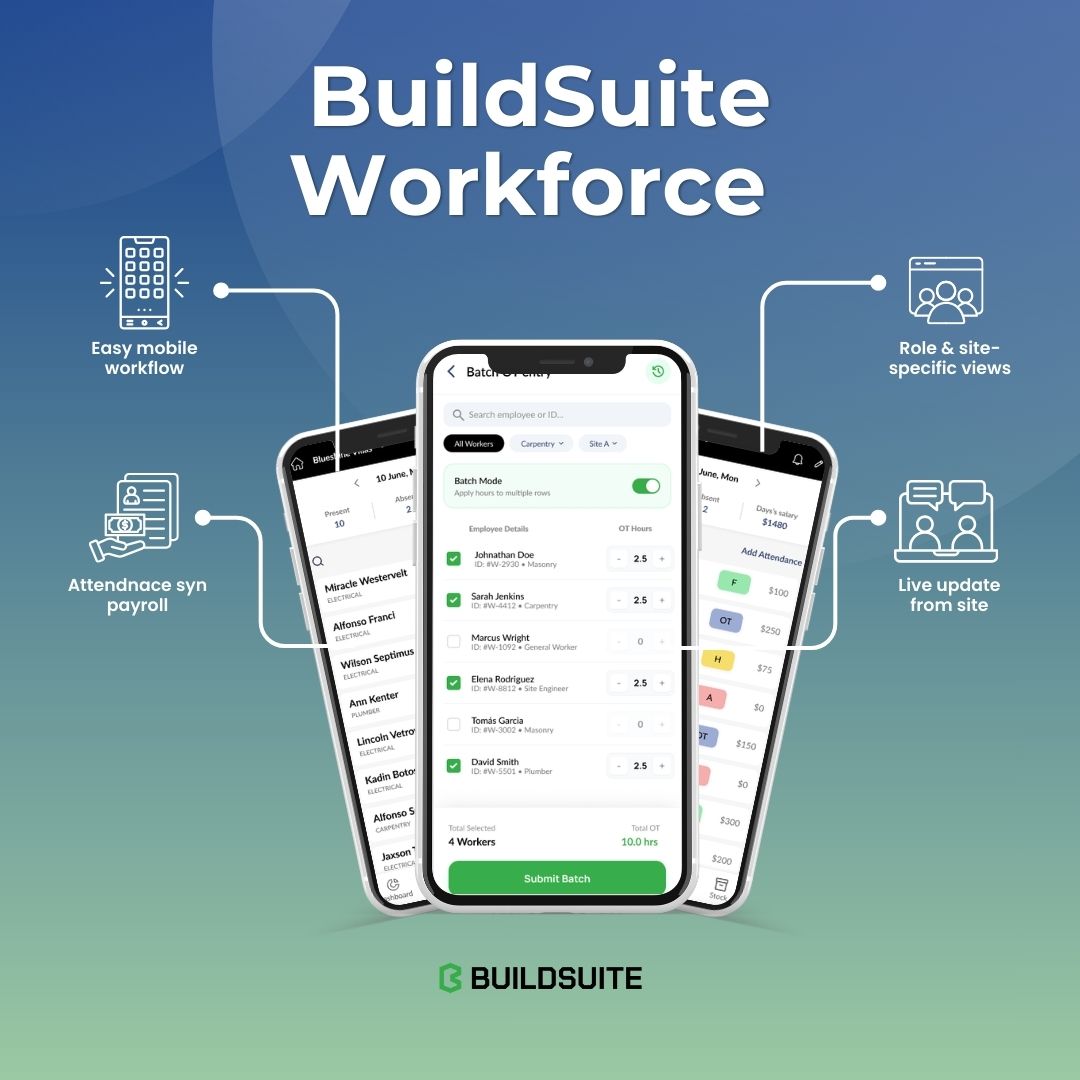
- Real-time OT logging by site supervisors (mobile/tablet-ready, even during live shifts)
- Automatic overtime rate application during payroll generation.
- Digital approval workflows to prevent unauthorized OT and streamline workflow.
- Dashboard access for HR, Site Engineers and Project Managers—with clear segregation of duties
- SIF generation in a few clicks for monthly or weekly payroll processes
- Compliance audit trail with full record-keeping (OT logs, shift overrides, approvals)
- WSP compatible
By eliminating manual attendance reconciliation, outdated Excel trackers, and inconsistent approval chains, BuildSuite puts construction HR teams back in control.
Whether you’re managing 30 workers or 3,000 across multiple sites, BuildSuite helps you reduce risk, cut payroll errors, and stay compliant without adding to your team’s workload.
Example Use Case: A supervisor logs that the plumbing crew stayed 2 hours extra. The system auto-applies Oman’s 1.25x rule, marks them under pre-approved work, and sends for manager approval
Visibility Reduces Risk
In the Middle East, where labor laws are strict and workforce diversity is high, clarity in overtime management is non-negotiable. Construction companies that still depend on manual logs or one-size-fits-all Excel templates are exposing themselves to:
- Payroll disputes
- Legal non-compliance
- Demotivated workers
It’s time to move toward transparent, real-time, and country-compliant overtime tracking and that starts with tools built for the realities of construction sites.
Want to simplify workforce tracking across your projects? See how BuildSuitecan help your team manage OT with confidence.
See how it works: Click Here
Contents
- 1 Why Overtime Isn’t Just “Extra Hours”
- 2 Overtime Laws by Country (With Comparison)
- 3 Country-Specific Nuances & Compliance Notes
- 4 UAE: The “Basic Wage” Focus
- 5 Saudi Arabia: Holiday = Overtime
- 6 Oman: “Forced” Overtime Premiums
- 7 Kuwait: Strict Quantitative Limits
- 8 jordan: establishing internal bylaws
- 9 The Real-World Challenges for Construction HR
- 10
- 11 How Modern Tools Like BuildSuite Simplify Overtime